
The Poorest County in Maryland
Brio arrived in Crisfield, Maryland on Sunday, September 28th. The next day we had a few errrands to do. While in the Marina office, we were offered a ride from our about-to-be town docent, Paul. Paul, who is in his late 70s and who spent his entire life in Crisfield, was a wealth of knowledge about the town. He spent much of his working life as maintenance supervisor at the medium-security state prison built in the 1980s. He told us several times that Somerset County was the poorest county in Maryland. It was evident by looking at the housing, much of which was abandoned and delapidated. Walking into town, many storefronts are boarded up. But there is another side of Crisfield.
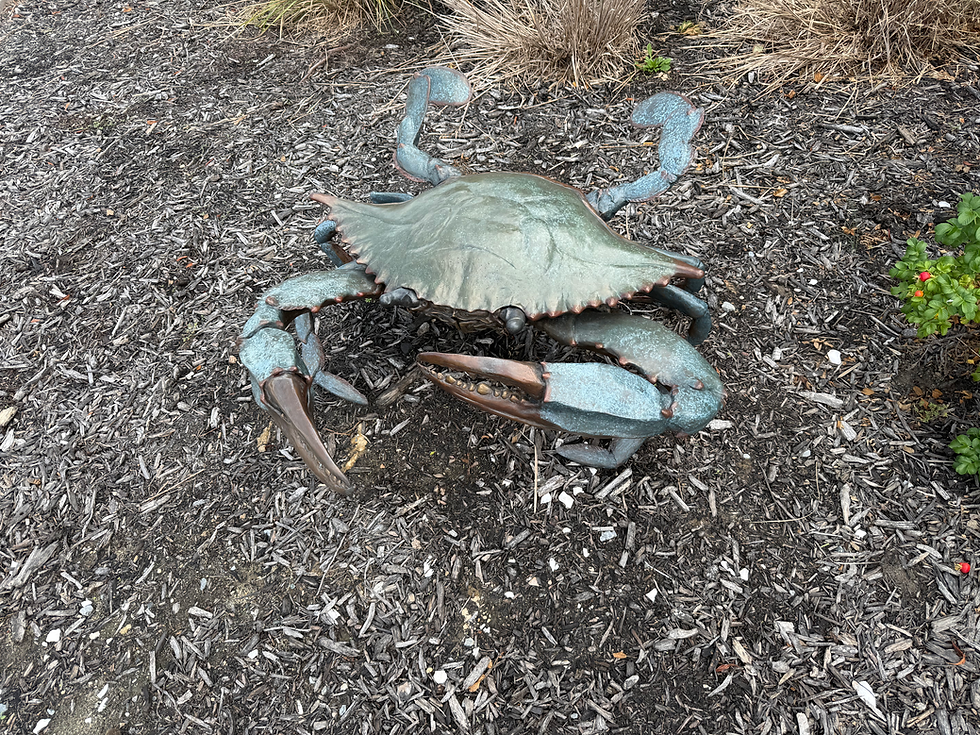
Crisfield's history has deep roots in oysters and crabs. This statue to a town hero pays quiet homage to its past. It is said that parts of Crisfield is built on oyster shells. The town was a bustling center of commerce in the 19th and early 20th century.
But these industries require hours of hard labor and, just as we saw with Tangier, the younger population began to move away in the 1980s. Paul tells us that the deathknell to this work came in the 1980s with the construction of the county prison, where he worked. Many crabbers and oystermen retired from their work to be employed by the state in the prison and other employers. The hours were much easier and there were benefits and a retirement.
The other creeping contributor to people leaving Crisfield was the land subsidence and sea level rising. Paul didn't know about the meteor impact crater that underlies the lower Delmarva Peninsula and Crisfield in particular. But he was aware that land subsidence was as much a contributor as sea level rising as high tides and flooding have become more and more of a problem. Driving around, it is clear that significant areas are flooded that Paul said used to be dryer and more usable.
Paul was particularly proud of one of Crisfield's famous families, the Ward brothers. The two men carved duck decoys that were highly sought after by hunters and collectors. Today, Paul says a pair of ducks his father had been given by the brothers for work his father did for them are appraised at $25,000 each.

But Paul kept saying, "Just wait. There's something really special I want to show you."

His church, a United Methodist church, is an incredibly beautiful edifice. Paul, in his very quiet way, is eager to show its beauty to the casual visitor. There were three of four earlier churches here, all of which burned down. This was built in the late 1920s only a few years after its predecessor had been destroyed by fire.
This painting, on plywood, was done by one of the brothers, Lem Ward.
If Lem wasn't entirely happy with a painting he had done, he signed the painting by spelling his name backward. This, of Daniel and the lions, was one that was signed backward. Why? It looks stunning.

Maybe those very human faces on the lions were meant to capture the faces of people he knew? Look at how expressive they are. Clearly, Lem was a student of humans.
Elsewhere inside the church one sees beautiful stained glass windows.

And ...

The church also has a carillon that is played by a 25-year old each Sunday. It can be heard a half-mile away, beckoning people to church.
Attendance has fallen from 100 years ago. There are only about 40 people each Sunday. Paul said that part of the problem was that they couldn't fit as many people in the pews and the alter rail ... because the parishioners were now too wide! Paul had a wicked sense of humor.

Here's Paul holding forth. Notice the sliding doors behind him that opens a side sacristry to the main sacristry. Paul told us one person can slide these doors open or closed easily.
The church is on the highest ground in the area. When floods are predicted, people bring their cars to park all around the church to seek the sanctuary the church provides.
Now that we were shown the challenges Crisfield faces as well as its resolute strength, we knew it was time to cast off and head to the western shore to our next stop, Solomon Island. There are many good "hurricane holes" up the several creeks behind the island where we could seek our own sanctuary if needed.
Cheers,
Brio


Comments